About the Project
Fed-BioMed for Federated-PET project
Project description:
FEDERATED-PET is a multicentric research project that aims to transform the use of medical imaging and artificial intelligence in oncology by developing predictive models for patients with metastatic lung cancer treated by immunotherapy.
More specifically, the project focuses on exploiting PET-CT imaging (18FDG) and clinical data to identify new biomarkers capable of predicting patient outcomes, such as progression-free survival and response to treatment.
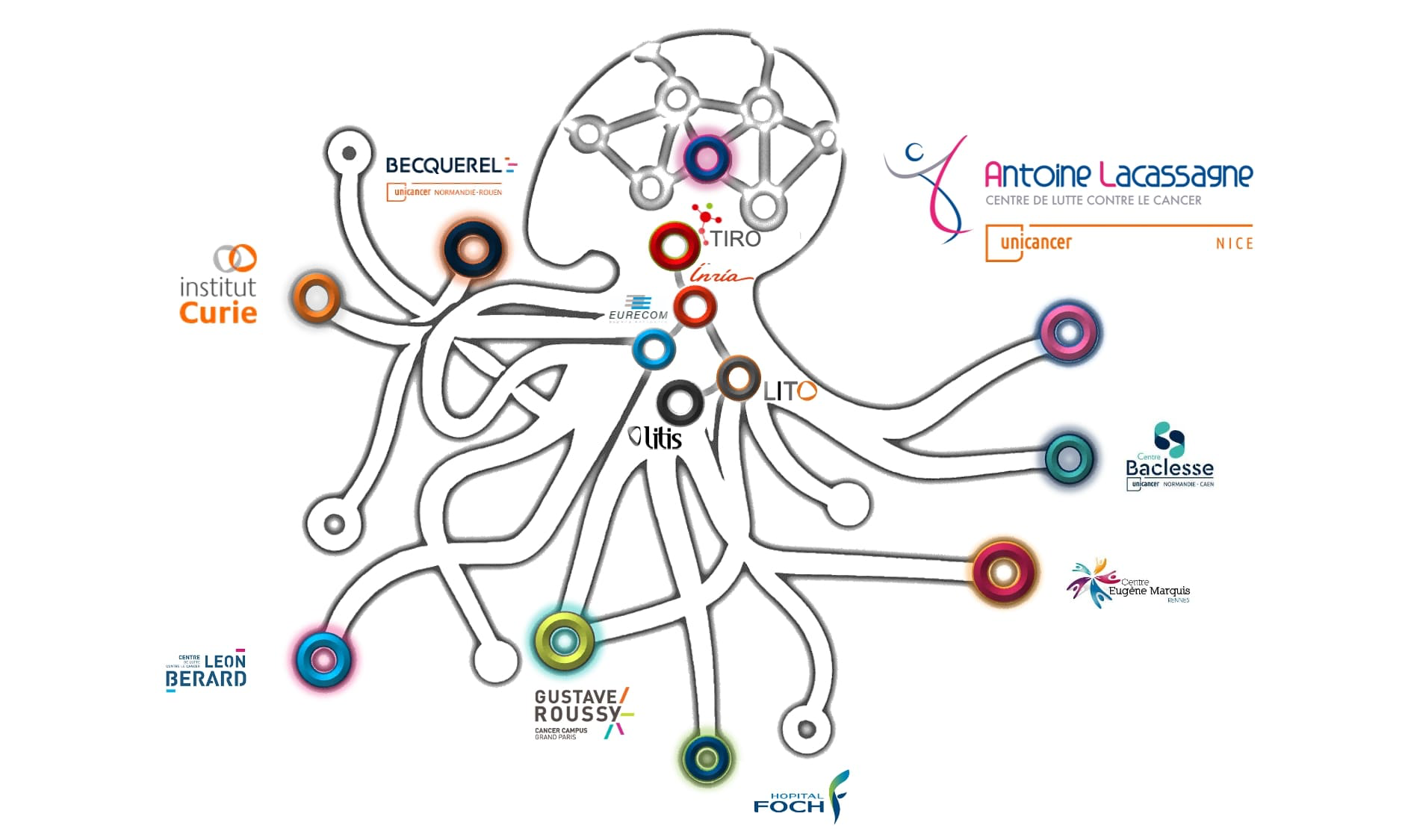
To achieve this, FEDERATED-PET brings together a network of 10 hospitals across France to build a large-scale, real-world dataset of more than 1,000 patients. The project leverages advanced deep learning techniques, including convolutional neural networks, to extract complex patterns from imaging data that are not detectable with conventional approaches.
A key innovation of the project is the use of federated learning, which enables collaborative model training across multiple institutions without requiring data sharing. This approach preserves patient privacy while allowing the development of robust and generalisable AI models.
Ultimately, FEDERATED-PET aims to enable more precise, personalised, and data-driven treatment strategies in oncology, improving clinical decision-making and patient outcomes while addressing the major challenges of data access and privacy in healthcare research.
Fed-BioMed position in the project:
Within FEDERATED-PET, Fed-BioMed serves as the core technological framework enabling the deployment of federated learning across participating hospitals.
It provides the infrastructure required to securely train AI models directly within hospital environments, ensuring that sensitive clinical and imaging data remain local while only model parameters are exchanged. This allows large-scale collaborative learning without compromising data privacy or regulatory compliance.
Fed-BioMed supports the full lifecycle of federated experiments, including deployment, orchestration, secure communication, and model aggregation across sites. It is progressively deployed across the network, from initial pilot centres to large-scale multicentric settings, demonstrating its scalability and robustness in real-world clinical environments.
In this context, Fed-BioMed plays a central role in bridging advanced federated AI methodologies with practical hospital constraints, enabling the transition of federated learning from research to routine clinical use and establishing a reference framework for future collaborative AI projects in healthcare.
-
Date
15 Jan 2026
-
Who
Fed-BioMed Team
-
Principal Investigator
Olivier Humbert (Centre Antoine Lacassagne)
-
Country
France