About the Project
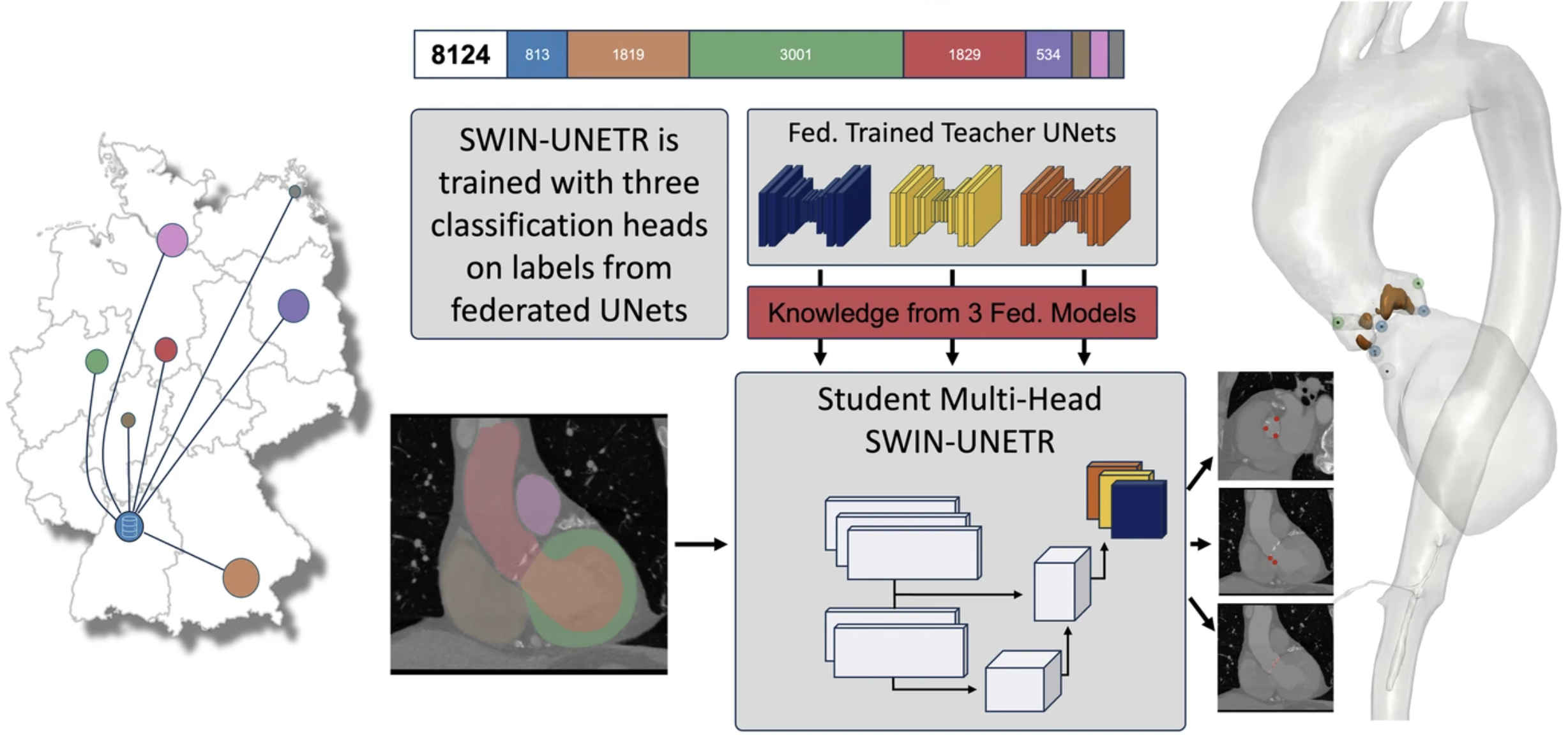
This research paper, published in npj Digital Medicine, presents a real-world federated learning approach for cardiac CT imaging using a knowledge-distilled transformer.
The study demonstrates how federated learning can be applied across institutions to train advanced deep learning models while preserving data privacy.
This work highlights the potential of federated technologies to enable collaborative medical research and improve clinical insights from distributed datasets.
Abstract
Federated learning is a renowned technique for utilizing decentralized data while preserving privacy. However, real-world applications often face challenges like partially labeled datasets, where only a few locations have certain expert annotations, leaving large portions of unlabeled data unused. Leveraging these could enhance transformer architectures’ ability in regimes with small and diversely annotated sets. We conduct the largest federated cardiac CT analysis to date (n = 8, 104) in a real-world setting across eight hospitals. Our two-step semi-supervised strategy distills knowledge from task-specific CNNs into a transformer. First, CNNs predict on unlabeled data per label type and then the transformer learns from these predictions with label-specific heads. This improves predictive accuracy and enables simultaneous learning of all partial labels across the federation, and outperforms UNet-based models in generalizability on downstream tasks. Code and model weights are made openly available for leveraging future cardiac CT analysis.
-
Date
06 Feb 2025
-
Who
Scientific Research Collaboration